Most teachers can name a dozen formative assessment examples on request. Exit tickets, mini whiteboards, thumbs up and thumbs down, a quick quiz at the end of a lesson. The list is easy. What separates a classroom where these tools change outcomes from one where they are simply another routine is what happens in the ten minutes after the evidence arrives.
That is the uncomfortable part of the idea. A check for understanding that does not alter the next lesson is not assessment. It is decoration.
What a formative assessment actually is
Ask what is a formative assessment and the textbook answer is that it happens during learning rather than at the end of it. That is true but incomplete. The defining feature is not the timing, it is the purpose. Formative assessment exists to give the teacher and the student information they can still act on while there is time to act.
A test you mark, record and never revisit is summative no matter when you gave it. A three-question check that makes you rewrite tomorrow's starter is formative even if it took ninety seconds.
Formative and summative are not rivals
The summative vs formative assessment debate is usually framed as a contest, which helps nobody. Schools need both. Summative work certifies what a student has achieved at a fixed point, which matters for reporting, progression and fairness. Formative work steers the teaching that leads up to it.
Problems appear when one is dressed as the other. Weekly tests that feed a running grade look formative and behave summatively, because students learn quickly that every answer counts. Once that happens they stop showing you their confusion, which is the only thing you actually needed to see.
The examples that earn their minute
Exit tickets remain the most reliable option because they are short, they are anonymous if you want them to be, and they arrive while you can still change tomorrow. Two questions is usually enough: one that checks the core idea, one that checks a common misconception.
Hinge questions are the sharper version. You write a single multiple choice question where each wrong answer corresponds to a specific misunderstanding, then you plan two different next steps depending on how the class splits. Whiteboard responses give you the same information in real time, at the cost of anonymity.
Then there is the low-tech classic that costs nothing: ask students to explain the idea to someone who missed the lesson, in writing, in three sentences. Vagueness is very hard to fake in that format.
Quizzes work, as long as the stakes stay low
Retrieval practice has one of the sturdier evidence bases in education. Pulling information out of memory strengthens it more than reading it again, an effect researchers call the testing effect. Frequent quizzing is therefore both a check on understanding and a form of learning in its own right.
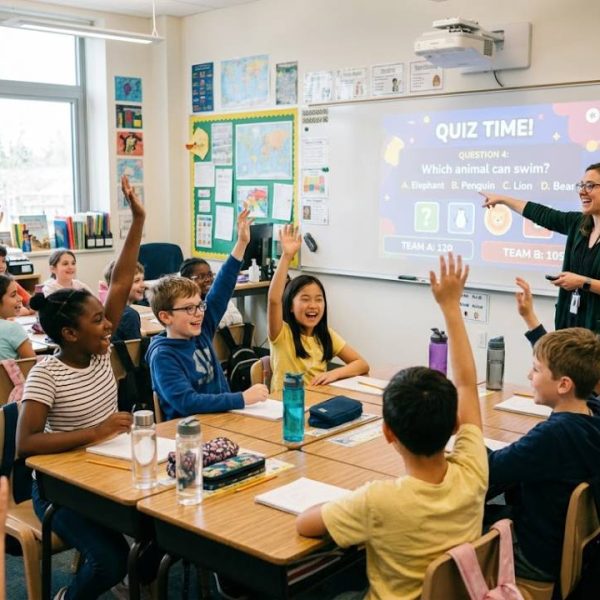
The condition is that scores do not follow students around. When a quiz is ungraded, a wrong answer is information. When it counts towards a report, a wrong answer is a threat, and students start guessing strategically instead of honestly. Interactive quiz tools help here because they make the process quick and slightly playful, which lowers the temperature. They also handle the counting, which is the part teachers should never be doing by hand.
Formative assessment depends on having enough adult attention in the room to notice what individual pupils are missing. Schools that recruit through volunteering opportunities effectively buy that attention, which is why classroom helpers show up so often in the research on responsive teaching. More eyes make faster feedback possible.
Reading the room without reading every answer
The most common objection to formative assessment strategies is workload, and it is a fair one. Nobody has time to analyse thirty responses every lesson.
Formative assessment works because it checks understanding continuously rather than at the end. Language workflows increasingly need the same design, with review built in rather than bolted on. That framing makes will ai replace translators the wrong question, since the useful one is where the checking happens.
The fix is to stop treating the data as something to mark. You are looking for a pattern, not a score. Sort the responses into three piles: got it, nearly, and lost. If the middle pile is largest, reteach the step where they slipped. If the third pile is largest, the lesson was built on a foundation that is not there yet. This takes about four minutes and produces a better decision than an evening of detailed marking.
Where it usually goes wrong
Three failure modes come up again and again. The first is asking a question the whole class can answer, which feels good and tells you nothing. The second is calling on volunteers, since the students who raise their hands are a biased sample of the room. The third is collecting evidence and then teaching the lesson you had already planned, because the slides were made on Sunday.
The third one is the hardest to fix, and it is the one that separates a school that talks about assessment from one that practises it. Plans have to be loose enough to bend.
It works better when students are in on it
Learners who understand why they are being checked behave differently in the moment. Explain that the quiz is for you, not about them, and confusion stops being embarrassing. That shift belongs to the same family as the student engagement strategies that keep a class involved rather than merely compliant, and it produces far more honest data.
Language matters here too. In classrooms where some students are working in a second language, a wrong answer may reflect the wording of the question rather than the concept behind it. Anyone who has looked at what makes some languages genuinely hard to learn will recognise how much cognitive load vocabulary alone can carry. Keep question stems short and plain, and you will measure the thing you meant to measure.
A week that looks different
None of this requires a new initiative. It requires two questions at the end of most lessons, four minutes of sorting, and the willingness to change the next lesson when the evidence says so. Teachers who do that for a term rarely go back, because the classroom stops surprising them in the wrong direction.