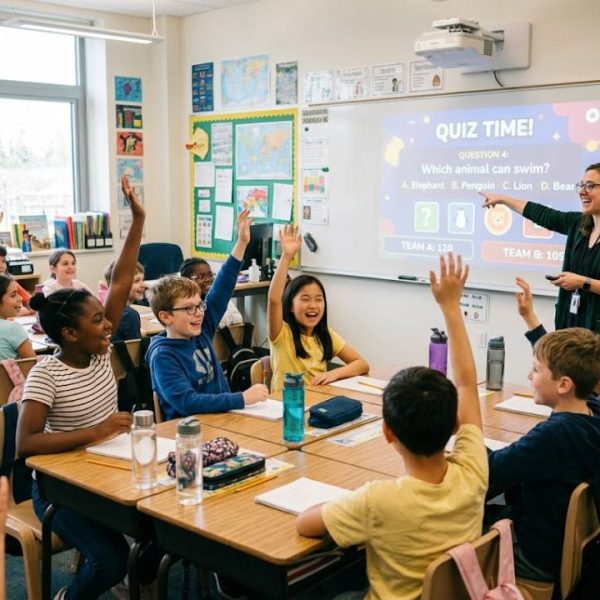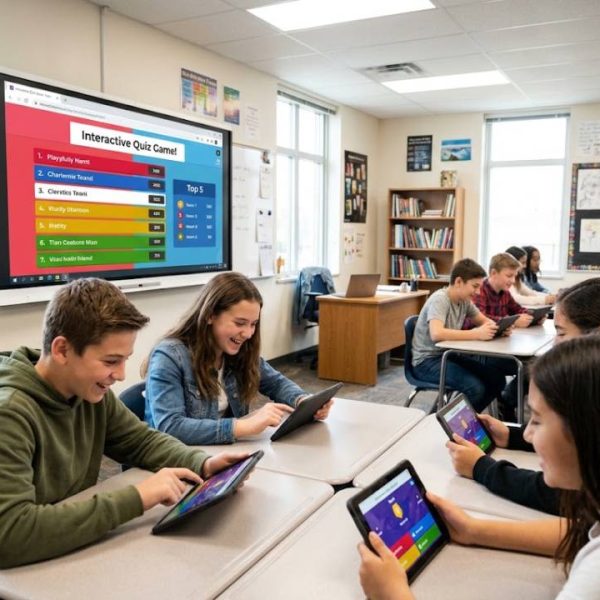
Anyone who has crammed for an exam knows how quickly facts fade. Interactive quizzes offer a better route. They ask learners to recall information, give instant feedback and add a dose of friendly competition. Here is how to use them well in the classroom, at home and in self-study.
Why recall beats rereading
Reading a page again feels productive, but it mostly trains recognition. Answering a question forces the brain to retrieve the information, and that effort is what strengthens memory.
Every time a student pulls an answer from memory, the next recall gets easier. Quizzes build that habit in small, low-stress steps.
Instant feedback keeps mistakes small
A wrong answer on a quiz is useful, because the correct one appears seconds later. The student fixes the misunderstanding before it settles in.
Compare that with a graded test returned a week later, when nobody remembers what they were thinking.
Games raise attention and motivation
Points, timers and leaderboards turn review into play. Quiet students often join in more readily when they answer on their own screen instead of raising a hand.
Keep the stakes light. A friendly game encourages risk-taking, while heavy pressure encourages guessing.
Start with clear learning goals
Before building a quiz, decide what students should be able to do afterwards. Name three or four skills and write questions that test exactly those.
A focused quiz of ten questions teaches more than a sprawling one of fifty.
Mix question types
Multiple choice is fast, but it should not be the only format. Add true or false items, short typed answers and ordering tasks to test different kinds of thinking.
Images, diagrams and audio clips make questions more concrete and help visual and auditory learners alike.
Write good wrong answers
Weak distractors make a quiz too easy. Base them on real mistakes students make, such as mixing up two similar terms or skipping a step in a calculation.
When students see these traps, they learn to slow down and think.
Use quizzes before, during and after a lesson
A quick opening quiz reveals what students already know. A mid-lesson check shows whether the class is following. A closing quiz locks in the main points.
Repeating the same material a few days later, with new questions, boosts long-term memory even more.
Learn from the results
Most platforms show which questions were missed most often. Treat that report as a map of what to reteach, not as a verdict on the students.
If half the class misses one item, the explanation may need a new angle, or the question may be unclear.
Quizzes for language learning
Vocabulary, grammar and listening practice suit the quiz format perfectly. Learners can match words with pictures, choose the correct verb form or decode a short audio clip. Anyone starting a new language will find helpful advice in these learning Italian tips for English speakers.
When a school also needs official documents or course material handled in another language, professional german translation services ensure that the result is accurate and ready to share.
Keep it accessible for everyone
Choose readable fonts, strong color contrast and enough time per question. Offer alternatives for students who need extra support, and avoid idioms that confuse learners of the classroom language.
Inclusive design means every student can show what they know.
Bring families into the picture
Share quiz links so that parents can follow along and cheer on their children. Short practice sessions at home turn homework into a shared activity.
The Edutopia teaching resource collects classroom stories and research that can inspire further ideas.
Quizzes for remote and hybrid classes
Online quizzes work well when students are not in the same room. A shared link, a live leaderboard and a short chat window recreate much of the energy of a real classroom.
Set clear time limits and test the link beforehand, so that technical hiccups do not eat into the lesson.
Let students write the questions
Asking learners to create their own quiz is one of the best review methods. To write a good question, they must understand the topic and think about likely mistakes.
Swap the finished quizzes between groups and let each team play the other's game.
Track progress over time
Save results from each session and compare them over weeks. A simple chart of average scores shows whether a topic has really sunk in or needs another round.
Avoid common pitfalls
Do not let the game overshadow the learning. If students chase speed over accuracy, adjust the rules by rewarding correct answers more than fast ones.
Also avoid running quizzes too often. Variety keeps the format fresh.
Build a routine that lasts
Choose a regular slot, such as a five-minute quiz every Friday. Students learn what to expect and begin to prepare on their own.
Over a term, these small sessions add up to a solid base of knowledge and a more confident class.